 Pasture Tally
Reading ADG: How to Spot the Doers and the Tail-Enders in Your Calf Crop
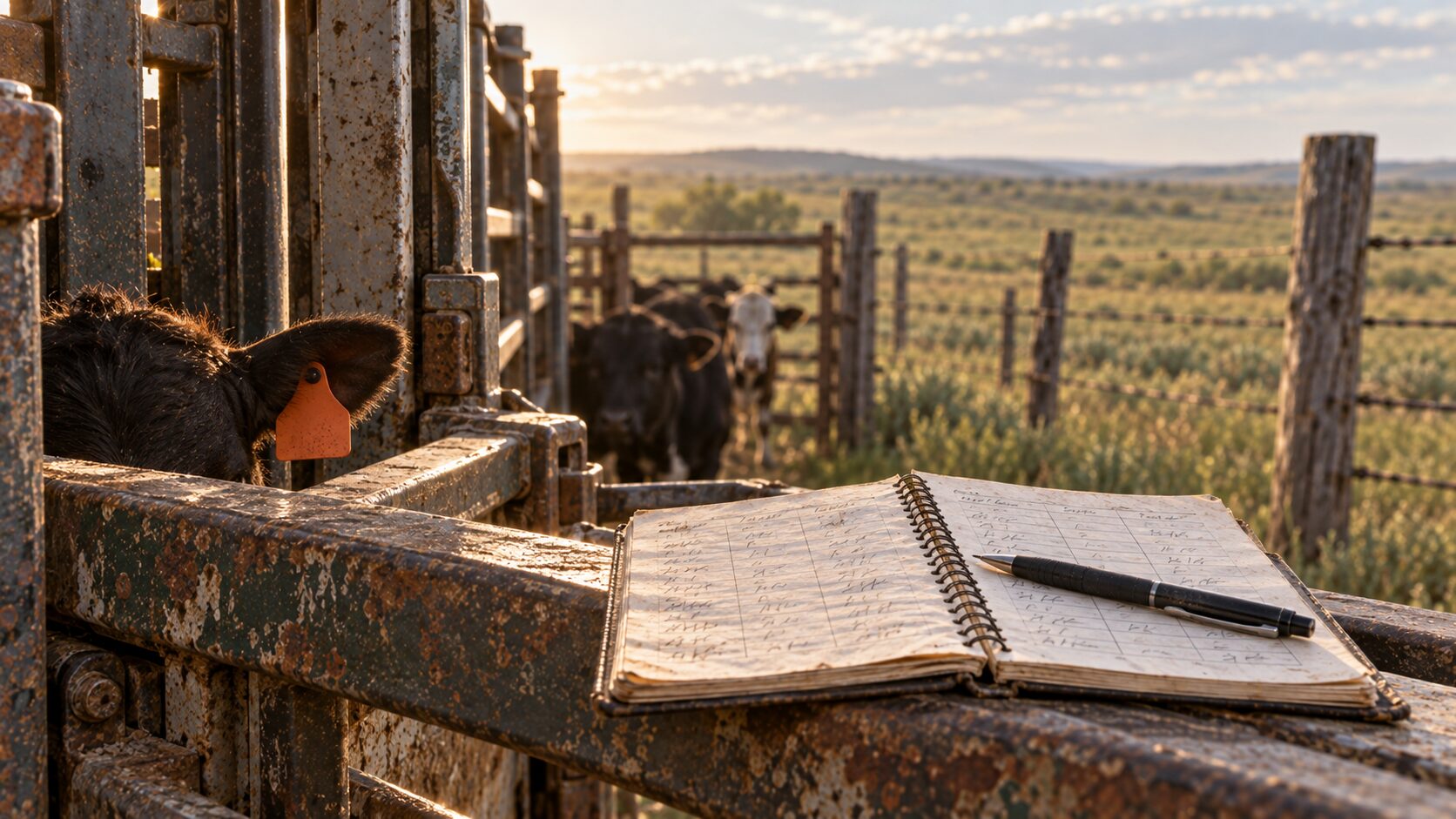
Weaning day. You’ve got 40 calves running through the chute, one at a time, hollering their heads off. Somebody at the head of the alley is calling out weights. Somebody else is writing them down.
You know a couple of the calves are heavy. You can see it. And you know a couple are light. You can see that too.
What you can’t see, standing at the alley: which calves gained the most since spring. Which cow-calf pairs are your top 20 percent. Which of these heifers actually earned a shot as replacements versus which ones just happen to look OK today.
That’s what ADG tells you. Not eyeball. Math.
What ADG actually is
Average Daily Gain. Two weights, the number of days between them, subtract and divide.
Calf weighed 220 lb on March 3. Same calf weighed 540 lb on October 3. That’s 320 lb of gain in 214 days. 320 divided by 214 equals 1.50 lb per day.
That number is worth more than either weight by itself. A 540 lb calf sounds fine until you learn one right next to him gained the same 320 lb starting from 180 lb, so he’s putting on weight faster on the same grass, same water, same management. Same cow herd. Different cow.
That’s where cull-and-retain decisions actually get made.
What “good” looks like by class
Ballpark ranges (real-world working numbers, not extension-service best-case):
- Nursing calf on a cow with average milk: 2.0-2.5 lb/day
- Nursing calf on a heavy-milking cow, good grass: 2.5-3.0 lb/day
- Weaned calf on grass (backgrounding): 1.5-2.0 lb/day
- Weaned calf on grain ration (backgrounding): 2.5-3.5 lb/day
- Yearling on grass: 1.0-1.5 lb/day
- Finishing steer on ration: 2.5-3.5+ lb/day
Steers tend to gain slightly faster than heifers on the same program, roughly a 5 to 10 percent edge. Breed matters. Continental crosses gain faster than pure British, but British finishes younger. Temperament matters more than most people expect: a wired calf that runs the fence burns calories a quiet one puts on his back.
When to weigh
You don’t need a truck scale to make this work. You need:
- A birth weight or spring weight. Write it down at branding, banding, or first working.
- A weaning weight. Everybody’s already at the chute anyway.
- A quarterly or pre-sale weight. Sale-barn scale on haul day counts.
Three data points per calf per year is enough to compute meaningful ADG windows: birth to weaning, weaning to yearling, whatever windows matter for your program.
You don’t need per-week weights. That’s a feedlot problem. In a cow-calf operation, quarterly is enough.
Reading the numbers on the group
One calf’s ADG is useful. Twenty calves’ ADG side by side is where the decisions live.
Look at three things:
- The median. The middle calf. Not the average. A single 3.0 lb/day doer will drag the average up and make a mediocre group look like a good one. The median tells you what a typical calf did.
- The spread. From the top calf to the bottom, on the same program. A tight spread (say 1.6 to 2.2) means uniform genetics and uniform management. A wide spread (0.8 to 2.8) means either your cow herd is inconsistent, or your management is: a fence-corner grass problem, or a bull-calf-to-heifer-calf skew, or bull power that isn’t matching cow numbers.
- The tail. The bottom 15-20 percent. These are the calves eating feed for months without catching up. In a 40-calf crop, that’s 6-8 head. Those are the culls to identify early, not the ones you keep hoping for.
Decisions the math enables
Once you’re computing ADG per calf, you can:
- Retain replacements from your top gainers. Not from the prettiest, from the ones that grew. Growth is heritable. Phenotype comes second.
- Cull tail-enders early. A calf gaining 0.8 lb/day at seven months old is not going to catch up. Feed him another 90 days and you’ve spent money you won’t get back at the sale barn.
- Identify your top cow lines. Trace ADG back to the dam. Any cow whose calves consistently show up in the top 25 percent of the crop is worth keeping past the age you’d cull an average one. Any cow whose calves are always in the bottom third is telling you something.
- Compare bull years. If your calf-crop ADG jumps 0.4 lb/day the year you turn out a new bull, that bull is earning his keep. If it drops, he isn’t.
None of these decisions can be made from eyeball. They need the math, and the math needs per-animal weight history.
Why paper doesn’t cut it for ADG
You can log weights in a notebook fine. What you can’t do in a notebook is sort 40 calves by ADG, filter to just this year’s heifer calves, or trace the top 5 gainers back to their dams. That takes columns, sortable rows, and a calculator you don’t have to key numbers into three times.
Every ADG analysis in a notebook takes an hour on the kitchen table, so most operations never actually do it. The math gets skipped, and the decisions get made on the eyeball again.
What works
Pasture Tally tracks weights per animal automatically. Enter a weight at any working, and the app computes ADG windows for every animal you’ve weighed more than once. Sort your herd by ADG. Filter to this year’s calves. See which dams produced the top 20 percent. See which calves are dragging.
The math is the point. The record is just what makes the math possible.
Start a free trial if you want to try it on your next weaning day. No credit card. Log the weights at the chute, and you’ll have ADG per calf before the trailer’s unloaded.
For the fuller 5-things record-keeping guide, see Cow-Calf Record Keeping.

Justin Pierce runs a cattle operation in Tahlequah, Oklahoma. He built Pasture Tally to keep his own herd records straight in the pasture.