 Pasture Tally
Running Cattle for Other People: A Working System for Owner Accounting
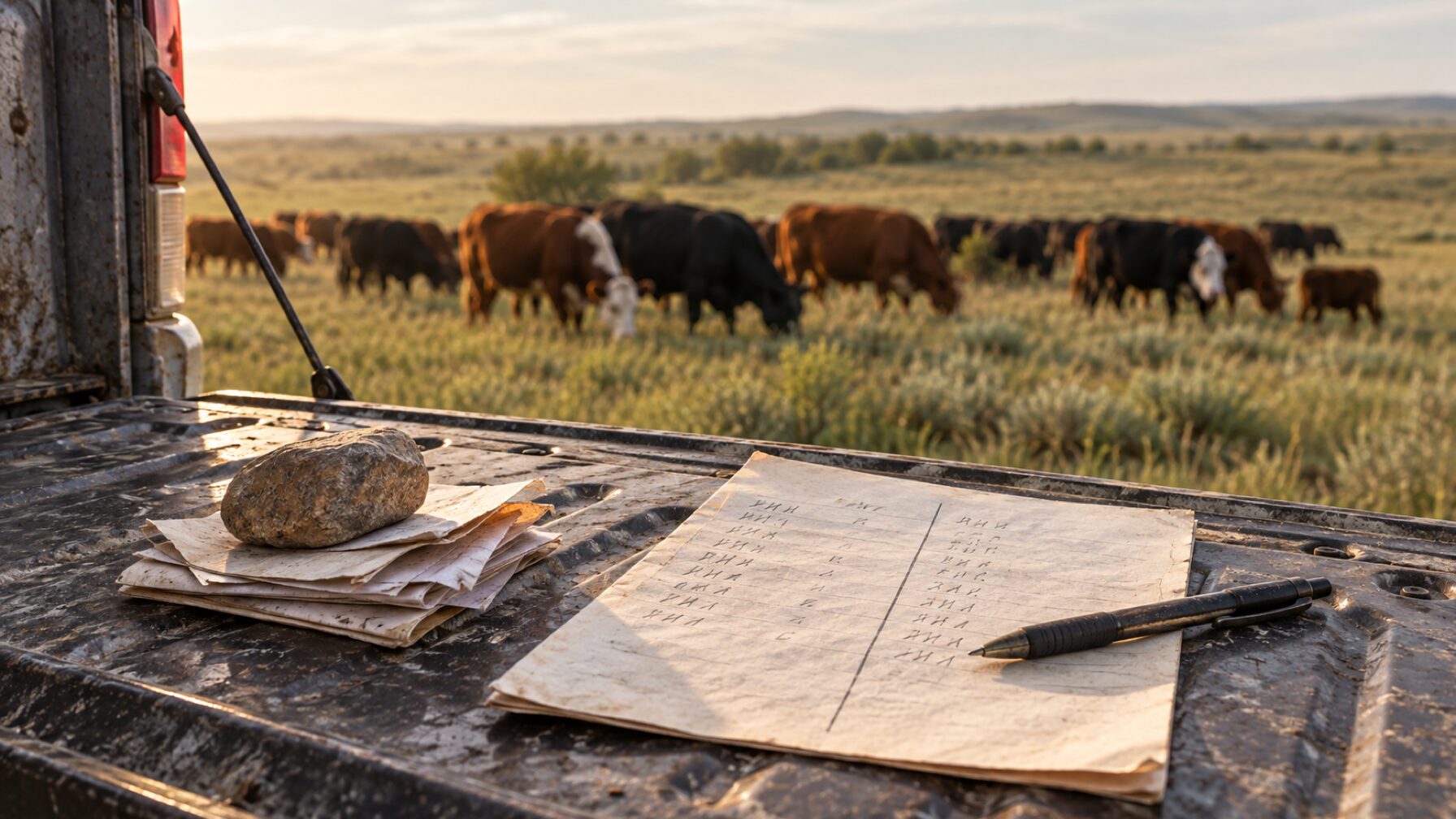
If you’ve been in the cattle business more than a few years, chances are you’ve had a cow on the place that wasn’t yours. Maybe your uncle bought a few head and boarded them with you. Maybe a neighbor leased out some pasture and you agreed to run his cattle on it. Maybe you got roped into a share arrangement where your labor pays for a stake.
However you got there, you’re now running cattle for other people. And come sale day, or vet-bill day, or tax season, somebody has to sort out who gets what.
Most operations start out doing this on trust and a handshake. That works right up until it doesn’t. A cow dies. A calf pens up with the wrong mama and you can’t tell whose it is. The hay bill for the whole herd needs splitting but nobody wrote down who had how many head in December. Somebody sells a set of steers and can’t remember which owner’s stock they came from.
You keep owner accounting so nobody gets shorted, so the trust holds up, so the vet knows who to bill, so the tax preparer has clean numbers, and so if anything ever gets contested you can pull up the record instead of relying on memory.
Here’s what a workable owner-accounting system needs to cover.
1. Who owns each animal, from day one
Every head on the place needs one thing written next to its tag number: an owner. If it’s yours, mark it yours. If it’s your uncle Bob’s, mark it Bob’s. If it came in with a leased pasture agreement, mark the lessor.
Calves are where this gets tricky. A calf inherits its dam’s owner by default, unless somebody says otherwise. If Bob’s cow throws a calf, that’s Bob’s calf. If you and Bob co-own a set of cows and split the calf crop somehow, you’d better have that split written down when the calf hits the ground, not six months later at weaning.
The animal record is the source of truth. When you’re standing at the corral trying to remember whose brindle heifer that is, the answer needs to be in one place you can pull up in a couple taps.
2. Sales and purchases, attributed to the right owner
When an animal gets sold, the money goes to whoever owned it. When an animal gets bought, the expense goes to whoever bought it. Simple in theory.
In practice, you’re often the one at the sale barn writing tickets and hauling the check home. That means every sale needs a note: which head sold, what they brought, and whose ledger it hits. Same on the buy side. If Bob buys three replacement heifers and you go pick them up, those heifers need to show up on his side of the books, not yours.
If you don’t attribute the money right when it changes hands, you’re guessing three months later. And guessing is how relationships get strained.
3. Direct expenses versus shared expenses
Some costs are tied to a specific animal. A vet call for cow 214. A dose of Draxxin for a steer with pneumonia. AI on a heifer. Those go directly on that animal’s owner’s ledger, no math needed.
Other costs cover the whole herd. Hay for the winter. Mineral tubs. Salt. Fence repair. Fuel for feeding. Property tax on the pasture if it’s shared. These are shared expenses, and they need to be split among owners in some way that’s fair and understood.
The important thing is to categorize the expense when you record it, not later. Was that vet visit for a specific cow, or a herd-wide vaccination day? Was that hay bought for winter feeding, or for one owner’s animals only? Write it down at the time.
4. Per-owner statements at settle-up
Every so often, everybody needs a real accounting. For most operations that’s annually, at year-end or after the fall sale. For some it’s quarterly. For a few tight arrangements it might be at every closing.
A per-owner statement should look like a real financial document, not a hand-scribbled note on the back of a feed receipt. Owner name, period covered, income (with the sales that generated it), direct expenses (with the animals they relate to), share of shared expenses (with the math shown), and a net for the period.
If you can hand that to an owner in a form they could give to their tax preparer, you’ve done the job right. If they have to ask you three follow-up questions to understand it, you haven’t.
5. When ownership changes, timestamp it
Partnerships evolve. Bob buys you out of half the herd. You buy back a set of cows he was running with you. A pasture lease ends and animals go home. When any of this happens, mark the date.
The reason: past sales and past expenses stay attributed to whoever owned the animal at the time. If Bob owned cow 214 all last year and racked up $340 in vet bills against her, that stays on his last year’s ledger even after he sells her to you this spring. The change-of-ownership timestamp is what makes that possible without a fight.
The math on splitting a shared expense
The simplest split, and the one most operations use, is head-count proportional. Add up everybody’s head, divide their share by the total, multiply by the expense. If you’re running 100 head and 60 of them belong to Uncle Bob, and the winter’s hay bill is $2,000, then Bob’s share is 60 divided by 100 times $2,000, or $1,200.
A few outfits go further. Class-weighted splits give a mature cow more weight than a calf because she eats more forage. Time-weighted splits prorate for animals that only ran part of the year (a set of heifers you took in April doesn’t owe for hay you fed in February).
For most operations, head-count proportional is clean, defensible, and matches what everybody expects. Pick one method and stick with it.
Why paper systems buckle on shared herds
Every one of these works fine in a notebook, right up until you have to reconcile mid-period changes on paper.
Bob adds twelve head in June. Somebody sells six in August. You spend $600 on hay in September for the whole herd. What’s each owner’s share? On paper, you’re now flipping between pages, counting head as of each date, prorating expenses, and hoping you didn’t miss a purchase.
Dam ownership on paper is worse. A calf hits the ground in April; you write it down as Bob’s calf. It nurses next to another cow all summer and you forget which one dropped it. At weaning, you’re guessing.
Statement preparation on paper is the killer. When you have to hand each owner a clean statement, you’re spending a weekend re-sorting your notebook by owner, adding it all up on a calculator, and hoping the totals match your bank deposits. This is why most shared arrangements devolve into arguments or vague hand-waving.
What actually works
A record system that assigns an owner to every animal, inherits the calf’s owner automatically from its dam at birth, categorizes expenses as direct or shared when you record them, and produces a clean per-owner statement any time you ask.
That’s what Pasture Tally does. Every animal gets an owner tag. Calves inherit from the dam by default, overridable in a tap. Expenses get tagged direct or shared at entry. Per-owner statements pull automatically for any date range, with a Spread Shared Costs toggle for the head-count math. Export any statement to a spreadsheet or a print-ready report and hand it to an owner at settle-up.
If you’ve been keeping owner accounts on paper and it’s starting to hurt, start a free trial. If it doesn’t fit your operation, uninstall it and go back to the notebook. But if you’re running cattle for other people, this shouldn’t be the part that hurts.
For the fuller 5-things record-keeping guide, see Cow-Calf Record Keeping.

Justin Pierce runs a cattle operation in Tahlequah, Oklahoma. He built Pasture Tally to keep his own herd records straight in the pasture.