 Pasture Tally
Cow-Calf Record Keeping: 5 Things Every Operation Should Track (and How to Keep From Losing Them)
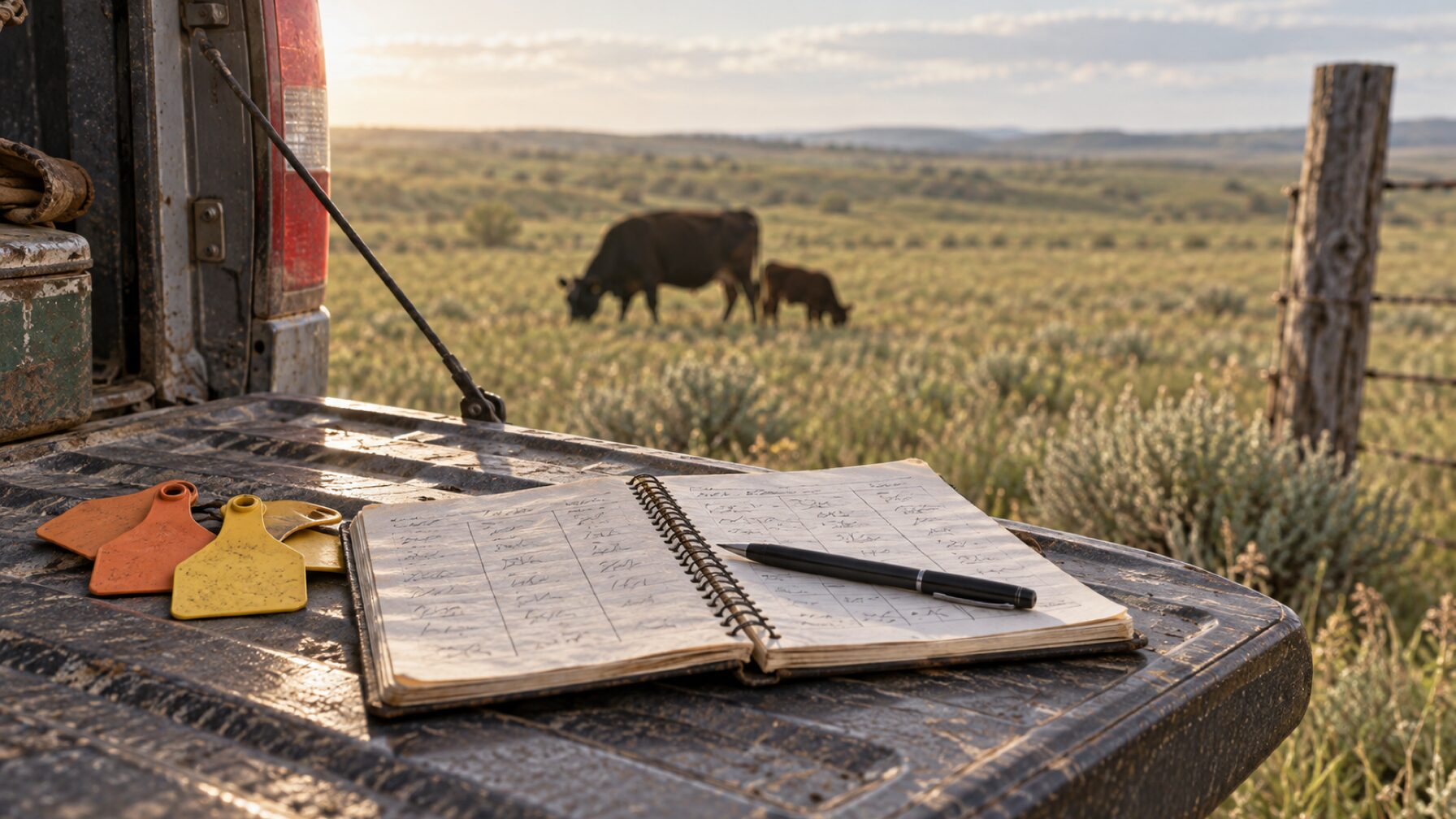
If you run cattle long enough, sooner or later you learn the same lesson every cow-calf operation figures out: the day you need a record is exactly the day you can’t find it.
It’s the tag number you meant to write down when the calf was pulled. The date you gave that steer his Draxxin. The bull you swore you’d remember bred cow 214 back in June. The bale count from the north field last fall.
You keep records so you can make decisions with numbers instead of guesses. You keep them so the vet, the banker and the tax preparer all have the same answers. You keep them so the cattle you run for other people get accounted for right when it’s time to settle up. And more than anything, you keep them so you’re not standing at the sale barn wondering how much money you actually made this year.
Here’s what a workable cow-calf record system needs to cover, and why each one matters.
1. Animal identity, with the whole story
Every animal on the place needs one record with a tag number, a class (cow, bull, heifer, steer, calf), a breed, a birth date, its dam and sire when you know them, and who owns it. That last part matters if you run cattle for anyone else. A lot of operations do, and the calf still needs to end up on the right settlement.
The mistake people make is treating the tag as the record. It isn’t. The tag is a pointer. The record is everything you know about that animal: every weigh-in, every treatment, every move to a new pasture, every time you almost sold him and didn’t. When the tag gets torn out at the head chute (and it will), you still know who’s who because you have a real record.
2. Breeding and calving dates you don’t have to remember
Cattle gestation is 283 days. That math is the same for everyone. But knowing a cow was bred on June 12 doesn’t help you if you’re standing at the corral in March trying to remember what “June-something” turns into.
A good breeding log tells you three things: when a cow was bred, when she’s due, and what she did when calving season came around (live calf, dead calf, twins, pulled, easy). The due date should just show up. You shouldn’t have to compute it. The outcome should link back to the calf’s own record automatically so the calf inherits its dam and sire without you re-typing anything.
If you preg-check, keep that too. Knowing who’s open in October saves you feed all winter.
3. Health treatments and withdrawal times, so you never ship early
This is the record that costs you the most money when you get it wrong. Every drug you give has a meat-withhold and, for lactating animals, a milk-withhold. Ship a treated steer inside that window and you’re liable if the packer catches it. Miss the ship date on the other side and you’re feeding him past his prime.
For every treatment record you should have: the animal it went to, the product name, the dose and route, the date, and the withdrawal end date. That last one is the whole point. When the truck pulls up on ship day, you need a clean answer to “who’s clear to go?” without flipping through months of notes.
Vaccination records matter too, for future protocols, for prospective buyers, for veterinary questions. Keep them the same way.
4. Weights and gain, to spot the doers
If you run them through the chute, weigh them while you have them. It doesn’t need to be every month. Every quarter, or at working, or at weaning, whatever fits your operation.
What you’re after is average daily gain (ADG). One weight tells you the size of a critter. Two weights tell you whether it’s earning its feed. Over a calf crop, a few points of ADG separate the ones you should retain from the ones you should sell.
You don’t need special software to do the math, but you do need the numbers written down consistently. A calf with three weigh-ins in his file is worth a lot more information than a calf with none.
5. Feed and hay inventory, so winter doesn’t sneak up
Running out of hay in February is one of the more expensive lessons in ranching. You avoid it by knowing three things: how much you baled off each field this year, how much you bought, and how much you’ve fed out.
For hay: date, field, cutting number, number of bales, rough weight. For feed purchases: what, when, how much, what you paid, where you stored it. For fed-outs: what you fed, when, and to which group.
If you’re serious, split it by storage location. Knowing you have 40 bales isn’t as useful as knowing you have 30 in the north shed and 10 in the barn, which is where you’ll actually go grab them.
Why paper cattle records break down
Every one of these records is fine in a notebook, right up until the notebook gets rained on. Or stays home when you need it in the pasture. Or you can’t remember which notebook the withdrawal date is in. Or you inherit six years of your granddad’s records and can’t find the ones for cow 88. Or tax time comes and you spend three days transcribing hand notes into a spreadsheet.
Paper works fine for a small operation with a great memory. For anything past that, it starts costing you time and money.
What actually works
A digital herd book that lives in your pocket, works when there’s no signal, and doesn’t lose data if the app closes.
That’s what Pasture Tally does. All five categories above live in one app: herd records with photos and lineage, breeding and calving with automatic due dates, health with automatic withdrawal countdowns, weights with ADG figured for you, and feed and hay inventory split by storage location. It runs entirely offline out at the corral and syncs when you get back to wifi. You can export everything as a spreadsheet or print a report any time.
If you’re keeping cattle records on paper today and it’s starting to hurt, start a free trial. No credit card. If it doesn’t fit your operation, uninstall it and go back to the notebook. Most people don’t.

Justin Pierce runs a cattle operation in Tahlequah, Oklahoma. He built Pasture Tally to keep his own herd records straight in the pasture.